Showing posts with label science. Show all posts

Friday, 24 February 2012

Review: Gödel, Escher, Bach

By Alan Go

I don't quite know how I decided that the best way to follow up Steven Pinker's epic history of violence was by picking up another 700 page mammoth, but apparently this did happen, which is why I spent the Christmas holidays trekking through Douglas Hofstadter's most famous work, Gödel, Escher, Bach: an Eternal Golden Braid. For a certain type of geek, this is as close as you can come to a sacred book, with Hofstadter as some kind of god, or at least a prophet. When mentioned online, it is referred to with reverence, as its devoted followers drown out the odd detractor, with their unrestrained praise.

That may be overdoing it a little (or a lot), but the point still stands that a fair number of people consider this book to have played a major part in their lives. Entire university courses can be based around it.

At this point, I should probably try to summarise what the book is actually about, although I confess to being slightly nervous about doing so. Whilst fairly confident that I understand its central messages, I wouldn't say that I'm certain, and it wouldn't surprise me if some subtle point has passed me by.

It is not about Kurt Gödel, M.C. Escher, and J.S. Bach, at least not centrally. Instead, the main thesis of the book concerns how meaning can arise from meaningless symbols, by using formal systems which contain tricks such as self-reference, self-replication, recursion and strange loops, and by using tools such as paradox, infinity, and isomorphism, and particularly examining how this relates to the emergence of intelligence from unintelligent neurons. Throughout the book, the works of the three geniuses in the title are used as a touchstone to which all these concepts can be linked to, showing how the same ideas are mirrored in their work, and in real life.

Wednesday, 14 December 2011

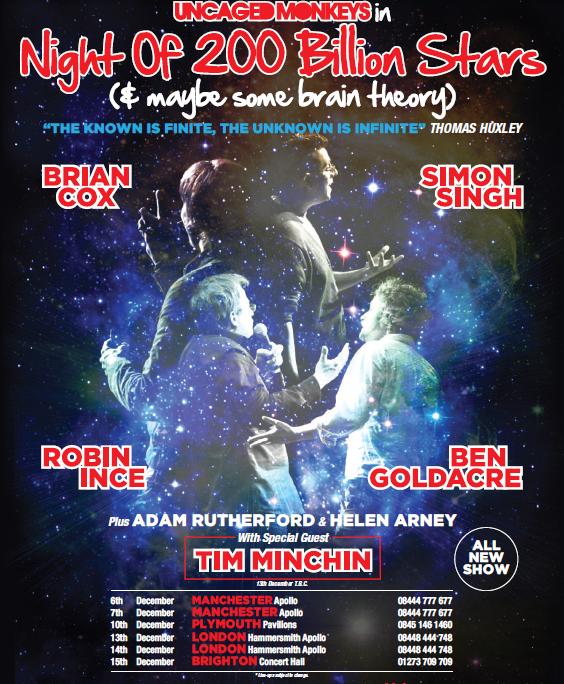
Review: Uncaged Monkeys


By Alan Go

‘The anus is very important’- Adam Rutherford
I’m not sure how often several thousand science lovers get the chance to assemble in a single venue, but I’m guessing not very. Uncaged Monkeys provided an opportunity for people to let out their inner geek, and to do so with pride.

It brought together many of Britain’s leading science communicators, allowing them to talk about the subjects they feel most passionate about, in the knowledge that they had an audience who would find them just as interesting. We therefore had Simon Singh (author of The Code Book take us inside a real German Enigma machine, Ben Goldacre (author of the Bad Science book and blog) give a disturbing, highly energetic talk on blobbograms, funnel plots, and the danger of publication bias, and Adam Rutherford showing us his tribute to Nasa’s space shuttle era on the giant screen, complete with deafening music. And this was all in the first half.
Comedian Robin Ince, who presents Radio 4’s The Infinite Monkey Cage along with Brian Cox, was in charge of festivities. He came across as a reflection of a large part of the audience, a layperson who though without a formal science education, was completely fascinated by the discoveries and the worldview that science provided, making him the perfect host.
The 13th of December was quite the day to hear Professor Brian Cox, pointer extraordinaire, speak. The 2011 results from CERN had just been released, showing ‘tantalising hints’ of the much sought after Higgs boson, causing Cox to go as far as to say that the day could become one of the most important in the history of physics. With almost everybody in the room having at least some idea of what this meant, Cox had the chance to delve into details that he might not normally give to a public audience. There can’t be too many occasions when the audience doesn’t flinch while complex equations are flashed up on the screen, or who only end up listen more intently as gauge invariance is being explained to them.
The audience was invited to send in questions via Twitter, with the questions split roughly evenly between the serious, and the not quite so serious. Our very own Mack provided the first question, asking Brian to reminisce about eating pies at Oldham Athletic (I didn’t actually hear the answer given; I was laughing too much at the time). A live Skype call to Prof. John Butterworth’s booze filled apartment in CERN was inevitably plagued with technical difficulties, although he did manage to nod a few times, and say the word ‘breakfast’ once to humorous effect.
Any time that wasn’t spent carefully concentrating on the speakers was spent laughing. Being funny and charming seems to go hand in hand with being an effective communicator, and everyone was prepped with nerdy jokes that the audience lapped up. Ince and Cox are both of course, well practiced in this game, and could spontaneously send ripples of laughter through the audience with impressive speed and wit. The crowd didn’t care much about which mode they were in, enjoying Goldacre’s serious and reasonably dark presentation as much as Josie Long’s skit about Darwin throwing salamanders and eating turtles.
A love of science, and a desire to spend an evening celebrating it, was the main thing binding the audience together, but the principles of rationality and scepticism were also loudly on display, with Singh tackling the Bible code, and Ince and Cox feeling free to make jokes at the expense of witches, homeopaths, and the 'nobbers' who believe in ghosts. This perhaps explains why a large part of the audience's reaction to Alan Moore (writer of Watchmen and V for Vendetta) was one of good-natured bemusement, as he discussed his belief in a 2nd century sock puppet snake god.
It also explains the warm reception for Tim Minchin, as he arrived just in time to sing two distinctly irreligious songs to close out the show. The first was new, (about magic Woody Allen Jesus) and the second, which closed out the evening, was his atheistic take on Christmas, White Wine in the Sun, accompanied by an impressive Brian Cox on piano.
If the evening proved one thing for me, it was that science saturation is impossible. The event lasted far longer than I expected (running from 7:30 to 11:00), but if it had continued for twice as long, I could have stayed happily transfixed in my seat.
To experience the wonder, power, and sheer interestingness of science, this was definitely the place to be.