Showing posts with label Alan Go. Show all posts

Friday, 24 February 2012

Review: Gödel, Escher, Bach

By Alan Go

I don't quite know how I decided that the best way to follow up Steven Pinker's epic history of violence was by picking up another 700 page mammoth, but apparently this did happen, which is why I spent the Christmas holidays trekking through Douglas Hofstadter's most famous work, Gödel, Escher, Bach: an Eternal Golden Braid. For a certain type of geek, this is as close as you can come to a sacred book, with Hofstadter as some kind of god, or at least a prophet. When mentioned online, it is referred to with reverence, as its devoted followers drown out the odd detractor, with their unrestrained praise.

That may be overdoing it a little (or a lot), but the point still stands that a fair number of people consider this book to have played a major part in their lives. Entire university courses can be based around it.

At this point, I should probably try to summarise what the book is actually about, although I confess to being slightly nervous about doing so. Whilst fairly confident that I understand its central messages, I wouldn't say that I'm certain, and it wouldn't surprise me if some subtle point has passed me by.

It is not about Kurt Gödel, M.C. Escher, and J.S. Bach, at least not centrally. Instead, the main thesis of the book concerns how meaning can arise from meaningless symbols, by using formal systems which contain tricks such as self-reference, self-replication, recursion and strange loops, and by using tools such as paradox, infinity, and isomorphism, and particularly examining how this relates to the emergence of intelligence from unintelligent neurons. Throughout the book, the works of the three geniuses in the title are used as a touchstone to which all these concepts can be linked to, showing how the same ideas are mirrored in their work, and in real life.

Friday, 17 February 2012

Review: Ill Fares the Land

By Alan Go

Something is profoundly wrong with the way we live today.

This is the opening line of the late Tony Judt’s short polemic about the crisis the Left has found itself in. Anybody who reads this and immediately begins nodding with a sincere expression will find plenty to like, and will no doubt admire the verve with which the book is written. I am sure it is a sentiment shared by many, but difficult to express with clarity; a problem to which the book tries to provide the answer.

The first chapter happens to draw largely from the last book I had read, and reprints many of the graphs from The Spirit Level in its call to reignite the fight against inequality. The message is an important one, and is referred back to frequently in the following chapters.

Judt tries to provide a brief history of the Left since the second world war, from the great enthusiasm for state planning and welfare that immediately proceeded it to the rise of individualism in the 60s, Thatcherism and Reaganism, and the decline in our belief in social democracy since then. Much of this broad brushstrokes history is told in such sweeping statements that it is easy to become sceptical of the simplicity of the narrative. In any case, I will admit to being unqualified to pronounce upon the accuracy of his account.

Thursday, 2 February 2012

Review: The Spirit Level

By Alan Go

Confirmation bias, seeking out evidence that supports our pre-existing beliefs, is among the most pervasive of our cognitive flaws, and something worth being on constant guard for. Whilst I may find life comfortable in the liberal, secularist space of ideas I have carved out for myself, I still try to recognise the danger of reading piece after piece that I agree with.

For these reasons, I attempted to restrain my enthusiasm after finding a book subtitled Why More Equal Societies Almost Always Do Better. I have written before about my fondness for a system of Rawlsian egalitarianism, and if I had wanted a book that provided empirical support for such principles, I doubt it would have looked too different. It can’t be too often that philosophical theories end up being tested against the evidence, so I was wary of any thesis that managed to show that one of my favourite thinkers has turned out to be exactly right. It all seemed slightly too fortuitous for my liking, but I was optimistic and hopeful.

Wednesday, 1 February 2012

John Rawls

By Alan Go

John Rawls is often called the most important political philosopher of the 20th century, and even the most important philosopher in this field since John Stuart Mill. His name and ideas have been referenced frequently in many recent articles about the Occupy movement. If Ayn Rand has been adopted by the Tea Party as their intellectual backbone, then maybe Rawls can have a similar role to play for Occupy.

Rawls is a liberal philosopher. He believes that everybody should have access to basic rights such as freedom of speech and expression, and the right to vote and stand for political office. Presumably there is not much to disagree with here. What is exciting though, is how Rawls arrived at this principle, and the other ideas that flow from this process.

He believes in a particular form of social contract. In order to decide what conditions in society would be fair, he asks what principles citizens would be willing to agree to, were they all to start with equal bargaining power. The contract is therefore a hypothetical one, made from what he calls the original position.Rawls reasons that some people have more resources or knowledge than others. This gives people differing amounts of power in negotiations, and any agreement that emerges is likely to be unjust.

Sunday, 15 January 2012

Review: The Better Angels of Our Nature

By Alan Go

In the IGCSE English language paper, the question was posed as to what historical time period we would most like to live in, were we given the choice. For various reasons, I maintained strongly at the time that the present was mostly definitely the place to be.

I had only suspicions about an overly romanticised past to go on at the time, but now I can safely claim that I have all the empirical backing that I could need.

In Steven Pinker’s latest tome, ‘The Better Angels of our Nature’, he seeks to lay out all the evidence for the historical declines of physical violence in all its forms, encompassing everything from wars and genocides, to infanticide and spanking, before taking some time to examine the causes of these declines by delving into the worlds of neurology and psychology.

With 700 pages of text, and a further 100 of notes, the volume is an imposing one. It is hard not to be intimidated, when starting a new chapter, you look ahead and realise there are over 100 pages of information left to go through on the subject.

It is a testament to Pinker’s skill as a writer that such a hefty subject never descends into dull academic prose or incomprehensible jargon. Instead we are given sentences that flow easily, spoken with a voice that neither patronises nor simply lectures. Nothing is dumbed down either. Pinker has no hesitation in explaining concepts of proability, randomness, logarithmic scales and the like, in order to give readers all the necessary tools to understand the various graphs and patterns under examination. The comprehensibility provides no clue as to the grand scope the book is trying to capture as a whole. Were you to give any small portion to any interested layperson, they would most likely be able to read, understand and enjoy it without any great difficulty.

Friday, 6 January 2012

Review: The Goat Rodeo Sessions

By Alan Go

Yo-Yo Ma is perhaps the most famous cellist alive today, and one of the most highly awarded classical music artists, with 16 Grammies to his name. I’ve heard and enjoyed his playing for many years now, and although he is renowned for being to play many different styles of music, I never thought he would be appearing on an album like this one.

Not that it is easy to say what exactly this one is. Bluegrass probably comes closest, but there is a strong Celtic feel to some of the tracks, with others almost able to pass for classical chamber music.

This collaboration isn’t quite as unlikely as it sounds, Ma having worked with double bassist Edgar Meyer on two albums previously, and also with mandolin player Chris Thile on his Songs of Joy and Peace album. Celebrated fiddle player Stuart Duncan completes the quartet of string virtuosos, who recorded their music in James Taylor’s home studio.

Sunday, 1 January 2012

What's going on in Hungary?

By Alan Go

h/t: Paul Krugman

After making ten amendments in their first year of power, the right-wing Fidesz government of Hungary, led by Prime Minister Viktor Orban, has now introduced an entirely new constitution. The word ‘republic’ has been removed from the official name of the country, but that is the least worrying change taking place. Every move from the current governing party has been heading in a disturbingly authoritarian direction, and there are deep fears for the future of a functioning, democratic Hungary.

With severe economic problems that have remained from the Soviet area, exacerbated hugely by the housing bubble and economic crisis, Hungary’s currency has been enormously volatile in recent years. Harsh austerity measures have been in place since 2007. The resentment towards the socialist party that had been governing since 2002 built up, resulting in a landslide victory for Fidesz in Spring 2010. They received 53% of the vote, which turned into a crucial 68% supermajority in the Hungarian Parliament.

The other beneficiary of the public’s discontent has been the Jobbik party, a former outsider with anti-semitic roots which even had its own paramilitary wing.

The most worrying change has been for the judiciary system, whose independence has been severely tarnished. Fidesz has been stacking the Constitutional Court with favourable judges, the age of retirement has come down, forcing many judges to retire immediately, and a single person now has sole authority to replace judges, move them to different positions, and even to decide which judge can hear each case.

Worrying new media laws have taken effect requiring an ambiguous standard of political balance. Self-censorship is already taking place, and one opposition friendly radio station was denied permission to have its license renewed. The new restrictions even apply to online media.

But perhaps the most blatant example of dictatorial behaviour concerns regulations about religion. There are 358 recognised faith groups in Hungary. Only 14 of them will be officially sanctioned. What this means for the remaining faiths, which include Islam and evangelical branches of Christianity, is not entirely clear. A two-thirds majority in Parliament will be required to have new faiths recognised. Orban seems to have made clear that he intends his country to be a Christian one. Marriage must be between a man and a woman, and all life is now protected from the moment of conception.

Interference with the Central Bank has destroyed the chance of a finanial bailout from either the IMF of the EU. Hungarian debt has been downgraded to junk status, and yields on ten year bonds are at an unsustainable 9.7%. If economic conditions stay depressed, as it is looking increasingly likely to happen, Hungary will struggle to escape from its budget deficit and other problems.

Fidesz’s popularity has dived since it came into power, and is now at less than 20%. However, the nature of the legislation they have rushed through is such that successive governments will have a hard time reversing the procedure. New electoral district boundaries have been drawn in such a way that Fidesz would have won all three of the last elections (two of which they actually lost). The terms of many official positions, including the head of the judicial office, and the head of the budget council, have been lengthened, and the people in those positions can stay in them unless new persons are agreed with a two-thirds majority. Other areas of law, such as tax policy, are also protected by this two-thirds supermajority requirement.

Although it has received considerably more attention than Syria, issues in Hungary have still failed to attract much attention from the press. International figures, including US Secretary of State Hilary Clinton, have expressed concern, but the fear is that countries will be too preoccupied dealing with their own economic crises to mount any form of effective protest.

Monday, 26 December 2011

Christmas Mass

By Alan Go

I was still reading new articles being written about Hitchens, where people reminisced about their favourite memories of him. This is why on Christmas eve, an hour before I was due to head off to midnight mass, I ended up watching the intelligence squared debate on the motion, ‘The Catholic Church is a force for good in the world.’ There is no shortage of people Hitchens has trounced in debates, but this must surely count as one of his most dominant victories. It is also one of the few occasions where he may not have been the most effective debater on stage, since Stephen Fry rather stole the show. Together, they walked over the ineffectual Anne Widdecombe and Archbishop John Onaiyekan. The numbers speak for themselves really:


Initial Vote: 678 For, 1102 Against, Undecided 346
Final Vote: 268 For, 1876 Against, Undecided 34

This put me in a slightly unusual state of mind as I entered the church. I almost felt ready to be antagonised, on alert for those statements which would cause offense, but I was to leave the church in a different, more complex mood altogether.

To put things in perspective, my family is very much of the ‘Easter and Christmas’ variety of Christianity, where nobody takes their Catholicism too seriously. This means I have had to attend only a few services as an atheist, since my deconversion several years ago, but it has been interesting to see how my experience has changed from year to year.

I should also make clear that I am not obliged to go to church, although my family say they would prefer it if I did. I mainly go because it seems preferable to spending an hour alone in my house. This means I am voluntarily entering into an area where I know I will hear things I disagree with, which would makes any complaining in my part in rather poor taste. In any case, I must confess to being far too afraid of quarrels to do such a thing, and even in the most egregious case, where the Bishop began urging the congregation to set evangelising as their top priority for the coming year, I was confident enough that no-one was taking him seriously, to leave the matter alone.

The religion in this church is well and truly of the moderate, mostly harmless variety, and not worth bothering at all.

My first mass after becoming an atheist was a disorienting experience. The rites and rituals which I had grown so accustomed to suddenly morphed from the sacred and spiritual to the bizarre and nonsensical. Praying for those who are sick or living in poverty seemed like a perfectly natural thing to do, but now it just represents an outdated belief in the power of intercessory prayer. It is impossible to realise how strange it looks to an outsider when the priest proclaims he is changing bread and wine into Jesus’s body and blood until you actually become an outsider, and then it looks very strange indeed.

I remember not quite knowing how to feel towards the congregation and priest at the time. Hatred for having lied to me, contempt for being so stupid, pity for being deluded, anger for being so self-righteous; all felt right at one point or another. Over the years, these have moderated gradually down, and now I just feel mostly bemusement.

The most striking thing upon entering the church this year was its relative emptiness. The hall is large, but only half the seats were occupied for one of the most important services of the year. There were no altar servers either.

I’ll admit to experiencing some schadenfreude upon noting these facts, although I do not know how much the drop in numbers is due to our parish’s uncharismatic priest, or any reasons other than a general drop in religiosity.

The combination of low attendance and slightly inept organist served to put a damper on what is normally the redeeming feature of any service, the music. On the whole, I prefer listening to Christian carols over most secular offerings at this time of year, probably due to the fact that I can still recite many verses from memory, and can even remember harmony parts, from my days in a choir. Considering that these people were celebrating the birth of their saviour, there was a notable lack of any festive spirit, which makes it less surprising that people would rather stay at home than spend an hour in forced seriousness before starting their family traditions.

This was the first time I’d attended mass since the catholic church had introduced some new modifications. In their quest to keep up with the times, church officials decided to go back to a more literal translation of the Latin. Instead of, ‘And also with you,’ we now have, ‘And with your spirit,’ and, ‘In one being with,’ has been replaced with, ‘Consubstantial with.’ There are various other harmless, synonymous substitutions, but my favourite has to be the addition to the confession of the words, ‘Through my fault, through my fault, through my own grievous fault,’ because apparently people just weren’t feeling guilty enough.

Curiously though, I could really feel the effect of these changes. I may have found the low level murmuring of responses in unison disconcerting once I no longer believed, but there was also a part of me that could feel the urge to join in. That’s the result of attending mass every week during your childhood. This allowed me in a way to reconnect with the sincerity I felt when I still had faith, and the profound feeling of the numinous that touched me on occasion when I was part of the community that muttered their quiet replies.

This time, the rhythm was no longer there. The words that were committed to memory no longer matched what was being spoken. It was as if a key anchor to the beliefs of my childhood had been removed, causing me to become yet more detached from my earlier state of mind.

I used to say that my lengthy time as a believing Catholic gave me some insight into the mind of a believer. I don’t think I can make that claim anymore. The growing confidence and clarity of my atheism has made the mental reasoning of believers increasingly alien, until I find it hard to empathise at all. Now, I realise that the emotional triggers are also fading.

Not that it matters too much. If I have lost anything of importance, I am sure I have gained enough to compensate, and then some.

Thursday, 22 December 2011

Intro to AI

By Alan Go

Everybody knows that the internet is exciting, that it has the capacity to connect people from distant parts of the globe, that it allows people to become as informed and as knowledgeable as they want, as well as a multitude of other useful things. It has already changed life for all of us dramatically (you wouldn’t be reading this but for Web 2.0), and there is yet another new application making its way online, with the possibility of delivering huge benefits to many people.

As easy as it is to find information online, the internet is messy, and seeking to learn a topic by googling it and reading up as much as possible can be a haphazard and frustrating process. The arrival of e-learning is seeking to change that. By having focused, passionate educators collate their material in one place, it has suddenly become much easier for any driven students to find all the material they need clearly presented in one place.

The excellent Khan Academy already exists to cover all of maths, and much science, to secondary level, and now the universities are starting to arrive in the game. MIT has had its open courseware around for a while, and Yale has a smaller selection, but neither seems to have caught on in any big way.

A major new experiment took place last term, organised by Stanford University. They announced three classes that would be running online, with the flagship one being Introduction to Artificial Intelligence, taught by Sebastian Thrun and Peter Norvig. This new course represented a big departure from the old style of simply recording lectures during the term, and dumping them online.

First, it borrowed some of the best features from Khan Academy. Hour long lectures were replaced by much shorter videos, recorded specifically for the online contingent, most lasting less than five minutes. Combined with the fact that these were interspersed with quizzes, where interactive software allowed you to check boxes, or enter numbers in answer to questions, this made the whole experience far more engaging and easy to follow.

For the first time, the class was being run exactly parallel to the actual version being taught on campus, with all the same material being covered. This meant that there was a real time limit set on the class, as opposed to being able to take some time off, and return back to the same point whenever you felt the inclination return. Enrolling in the course meant making an active commitment to set time aside each week to watch the videos and learn the material.

It also meant that there was an online community of students all taking the class at the same time, adding strongly to the sense or realism, whilst also providing a group of people to ask questions to, and to provide help, if you struggled with a particular topic. Perhaps most importantly, they acted as your competition. At the end of the course, you would receive a letter of accomplishment from the two instructors (although not endorsed by the university), which stated your rank within the class, based on a combination of your homeworks and the two exams.

In ten weeks, the course sought to provide a brief overview of the many different topics covered by AI. The first half was more theoretical, dealing with search algorithms, formal logic, and the topic I enjoyed most, probability, more specifically learning about Bayes theorem, and its uses.

After the midterm exam, we took a look at practical applications, namely game theory and planning, computer vision, natural language processing and robotics. The highlight in this section was the chance to hear Prof. Thrun speak about his own work on driverless cars, and his experience in winning the 2005 DARPA Grand Challenge. Watching videos demonstrating the impressive skill of these vehicles, while learning the principles that governed them felt almost futuristic in a sense, but also represented what could be the next area where AI research could make big impact. Google has already used driverless cars in creating its Streetview, and it seems likely that this technology could start to diffuse into the mainstream very soon.

What then were the results of this ambitious experiment? From a personal standpoint, I am happy to call it a promising success. This really was a first of its kind, but managed to be hugely enjoyable and rewarding. Credit for this must go to the two professors, whose enthusiasm for their subject translated clearly into their videos, especially during the virtual office hours, when they would take the time to answer submitted questions, and where their broad knowledge and expertise became apparent.

Obviously and understandably, there are many improvements to be made. The setup wasn’t yet there to incorporate programming assignments, the only difference between the online and campus versions. Some of the earlier videos weren’t particularly smooth, and it can be hard finding good questions that can only be answered by multiple choice or numerically. The site also had a habit of crashing near homework deadlines, showing that some things, like last minute scrambles to finish work, will always stay the same, whatever the medium. The final exam (pdf) was disappointingly easy, but if that’s the kind of thing I’m complaining about, then I certainly shouldn’t be too upset.

More than 20,000 people completed the course, but most of the statistics on the class are still unkown. Prof. Norvig is set to speak at TED in February, where he will hopefully provide more information.

This project has hopefully cleared the way for this type of experience to become more frequent. Stanford University are continuing with a new set of classes (do sign up, you have nothing to lose) available next term, and it will be interesting to see how other universities will respond.

It has also prompted a lot of questions to be asked about the future of education in general, and of the role of universities in particular. Is the best use of a teacher really to stand in front of a class and deliver lectures with minimal student interaction? Will it become possible to receive more official accreditation for completing this type of class? Will there still be the same demand to attend prestigious, expensive universities and schools if all the material is online? How many professors will have the enthusiasm to run an online course successfully?

However these questions eventually get resolved, I am confident that an improved education structure will emerge, where high quality content is more accessible, and where it is far easier, for far more people, to achieve their potential.

Friday, 16 December 2011

To Hitch

By Alan Go

There are too many hurdles in life to learn of them all by trial and error. That is why we look for the people greater than ourselves, those who can act as role models, and teach us the vital lessons so we may learn them more quickly, and without stumbling.

Christopher Hitchens was one of those people for me. I spent much of today watching his old videos, reading obituaries, and going through his old material. I realised while doing this, that if he had not featured in my life, I would have been a significantly different person, and the worse off for it.

Most obviously, he constantly reminded me of the importance of secularism. As one of the major causes of his life, he sought to impress upon people the danger that lay in religion, and in relying upon it for any kind of morality or wisdom. This for him, was simply an extension of his lifelong fight against totalitarianism, inspired by his own hero, George Orwell.

More generally, he taught me not to fear accusations of stridency. Although such an approach should not be used indiscriminately, if there is a practice that we find barbaric, or a belief that is obvious nonsense, we must not let charges of militancy or disrespectfulness prevent us from making our point. A movement needs people charging ahead at the front, daring to speak out in spite of taboos. Neither Mother Theresa, nor Mohandas Gandhi, was safe from his criticism. His willingness to call out religion for what it was, let fellow atheists know that someone was fighting their cause, and gave them the courage to join him in standing up for their beliefs.

An influence I feel keenly as I type this, is that of his writing. It is no exaggeration for me to say that I know of no finer non-fiction writer, or anyone who could match the elegance of his prose. Sitting among a list of people writing about atheism who are renowned for their clarity and readability, it was universally acknowledged that Hitchens was the best. Any time a new piece of his appeared in my rss feed, I would jump to it straight away, knowing I was guaranteed an essay filled not only with sharp insights, but also composed of beautiful sentences. This ability of his came out especially when he started writing about his illness. In particular, there is an article I regularly go back to about the importance of his voice. Every sentence is vibrant and sparkling.

One can become quite used to the specter of the eternal Footman, like some lethal old bore lurking in the hallway at the end of the evening, hoping for the chance to have a word.

His voice resonates strongly, as it does through all his work. When I read Hitch-22 or god is not Great, his voice immediately arrives in my head, reading to me aloud with perfect clarity. When I write, it is always with his voice and style in mind.

I stand firm in my conviction that the naturalistic worldview holds greater attraction than any spiritual one. The universe is wondrous enough as it is, and we can do without the distractions and obfuscations of the religious. But still, death is certainly a moment where it can be possible momentarily to struggle for positives. Hitchens led by example, and now, his example is no longer with us. When I think of the sentences that might yet have been written, and the speeches that will now go unspoken, it is impossible not to shed a tear. The world has lost one of its greatest writers, and is undoubtedly a less interesting place.

So we should mourn, but not too much. There is work left to do, and one less person left to do it. If you wish to pay tribute, then raise a glass and join the toast:

To Hitch.

Thursday, 15 December 2011

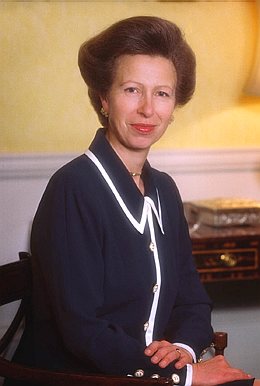
Reflections on a Royal Visit

Now that the event has passed, I am finding trying to write something about it unexpectedly difficult, and disconcertingly depressing. Certainly it counts as one of the few times, if not the only one, where knowing that I was representing the school filled me with more shame than pride.

If this is coming across as melodramatic, then that has been one of the problems with the whole affair. Questions over the sincerity of my concerns, as well as the nonchalance with which the majority of the school went along with everything, have formed a key element of my frustrations. I really am proud of my school. I thought we were the epitome of a liberal educational establishment, fighting to provide equality of opportunity, not caring who you are, or where you came from. By chance or design, I was in a school whose values I both shared and cared deeply about.

Except that on that one day, it did not feel like that at all. With the lower sixth in the standing upright in perfect silence in the Winterflood theatre, awaiting the entrance of the princess, so that she could be the first to sit down and enjoy all of the five minutes of the play she was going to watch, I could only feel embarrassment that my school was giving such a ludicrous level of respect to such a figure. Apparently our school is so confident in its pupils that the best way to showcase our talent is through a mixture of highly artificial demonstrations, and trying to keep the students out of sight. And also with a second plaque in the concourse to commemorate the visit. I don’t think I can come close to understanding why the school feels she is that important to us.

But perhaps the most galling think is that I managed to do precisely nothing in voicing my protest. A petition was ostensibly dropped for being too confrontational, but it was due just as much to a lack of support from peers, as well as varying levels of hostility from teachers. I thought that I could at least write a letter, but by this point, I was doubting what there was left to gain. I had wanted to see the school defend itself, to admit that this was all a cynical marketing ploy for good publicity, but would good would that have accomplished? No reply, it seemed to me, could have helped the situation.

Maybe I was just trying to find an excuse to avoid the battle. I was disheartened enough by events for this to be plausible. But for whatever reason, nothing was said.

The real kicker, and what upsets me most, is that I do understand how this could work out in the school’s favour, and how the publicity might even lead to us being able to fund more sponsorships. I profess only a tentative belief in my original position now, but even this strikes me as somewhat irrelevant. Even if I am wrong, there was a view that went unrepresented. And that may have been my fault.

So not only did fellow students not agree with me, many did not even take me seriously, or worse, did not care. Not only had my school invited a vip I did not care for, but to protest that decision afterwards could only make the school look worse. Not only did I feel strongly about the situation, but because of cowardice or whatever other reason, I did nothing of any note. Not only did I not do anything that I wanted to do, but it could be the case that I was wrong all along, and that using members from the royal family is a route to a net benefit for the school.

As I said depressing.

I’m not sure anyone, least of all myself, comes out of this in a good light.

Wednesday, 14 December 2011

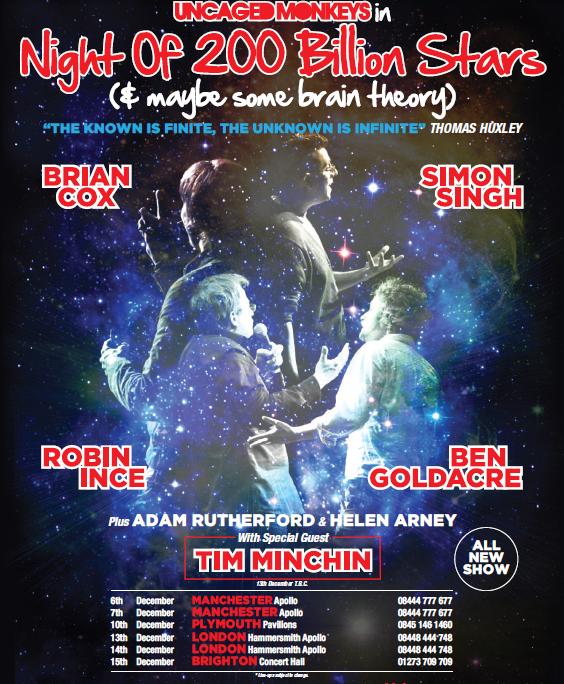
Review: Uncaged Monkeys


By Alan Go

‘The anus is very important’- Adam Rutherford
I’m not sure how often several thousand science lovers get the chance to assemble in a single venue, but I’m guessing not very. Uncaged Monkeys provided an opportunity for people to let out their inner geek, and to do so with pride.

It brought together many of Britain’s leading science communicators, allowing them to talk about the subjects they feel most passionate about, in the knowledge that they had an audience who would find them just as interesting. We therefore had Simon Singh (author of The Code Book take us inside a real German Enigma machine, Ben Goldacre (author of the Bad Science book and blog) give a disturbing, highly energetic talk on blobbograms, funnel plots, and the danger of publication bias, and Adam Rutherford showing us his tribute to Nasa’s space shuttle era on the giant screen, complete with deafening music. And this was all in the first half.
Comedian Robin Ince, who presents Radio 4’s The Infinite Monkey Cage along with Brian Cox, was in charge of festivities. He came across as a reflection of a large part of the audience, a layperson who though without a formal science education, was completely fascinated by the discoveries and the worldview that science provided, making him the perfect host.
The 13th of December was quite the day to hear Professor Brian Cox, pointer extraordinaire, speak. The 2011 results from CERN had just been released, showing ‘tantalising hints’ of the much sought after Higgs boson, causing Cox to go as far as to say that the day could become one of the most important in the history of physics. With almost everybody in the room having at least some idea of what this meant, Cox had the chance to delve into details that he might not normally give to a public audience. There can’t be too many occasions when the audience doesn’t flinch while complex equations are flashed up on the screen, or who only end up listen more intently as gauge invariance is being explained to them.
The audience was invited to send in questions via Twitter, with the questions split roughly evenly between the serious, and the not quite so serious. Our very own Mack provided the first question, asking Brian to reminisce about eating pies at Oldham Athletic (I didn’t actually hear the answer given; I was laughing too much at the time). A live Skype call to Prof. John Butterworth’s booze filled apartment in CERN was inevitably plagued with technical difficulties, although he did manage to nod a few times, and say the word ‘breakfast’ once to humorous effect.
Any time that wasn’t spent carefully concentrating on the speakers was spent laughing. Being funny and charming seems to go hand in hand with being an effective communicator, and everyone was prepped with nerdy jokes that the audience lapped up. Ince and Cox are both of course, well practiced in this game, and could spontaneously send ripples of laughter through the audience with impressive speed and wit. The crowd didn’t care much about which mode they were in, enjoying Goldacre’s serious and reasonably dark presentation as much as Josie Long’s skit about Darwin throwing salamanders and eating turtles.
A love of science, and a desire to spend an evening celebrating it, was the main thing binding the audience together, but the principles of rationality and scepticism were also loudly on display, with Singh tackling the Bible code, and Ince and Cox feeling free to make jokes at the expense of witches, homeopaths, and the 'nobbers' who believe in ghosts. This perhaps explains why a large part of the audience's reaction to Alan Moore (writer of Watchmen and V for Vendetta) was one of good-natured bemusement, as he discussed his belief in a 2nd century sock puppet snake god.
It also explains the warm reception for Tim Minchin, as he arrived just in time to sing two distinctly irreligious songs to close out the show. The first was new, (about magic Woody Allen Jesus) and the second, which closed out the evening, was his atheistic take on Christmas, White Wine in the Sun, accompanied by an impressive Brian Cox on piano.
If the evening proved one thing for me, it was that science saturation is impossible. The event lasted far longer than I expected (running from 7:30 to 11:00), but if it had continued for twice as long, I could have stayed happily transfixed in my seat.
To experience the wonder, power, and sheer interestingness of science, this was definitely the place to be.